How to Create Healthcare CRM Software? - Step By Step 2026 Guide
Posted By : Kuldeep Kr. Verma, Posted Date : Mar 07, 2026
The Healthcare sector is undergoing rapid transformation. In the present day, hospitals and clinics are not just facilities for treatment; they are service providers that, to succeed, must establish a loyal patient base. So, Healthcare CRM Software is the answer. It allows healthcare practitioners to handle patient information, enhance communications and simplify everyday tasks. Are you willing to discover how to create healthcare CRM software that will connect the doctors and patients? We will dive deep into the steps and strategies required to build a high-quality system that meets modern medical standards.
At Duplex Blogs, we understand that technology in medicine is about saving time and lives. Developing a custom CRM allows healthcare providers to move away from messy paperwork and fragmented systems. By centralizing information, clinics can offer a personalized touch to every patient.
Table of Contents
- What is Healthcare CRM Software?
- Healthcare CRM vs EHR- Understanding the Difference
- Why Do You Need Healthcare CRM Software?
- Key Features of Healthcare CRM Software
- Advanced Features to Include in Your CRM
- Exploring the Different Types of CRMs in Healthcare
- Step by Step Process to Create Healthcare CRM Software
- Challenges in Healthcare CRM Development
- How to Choose the Best Software Development Partner?
- Conclusion
What is Healthcare CRM Software?
Healthcare CRM software is a customized solution that helps manage the relationship between healthcare providers and patients. It is more focused on medical history, appointment scheduling and patient engagement as opposed to a general CRM. It functions as a link, integrating clinical information with communication tools so that patients will always be able to experience excellent care and attention during their whole treatment.
Healthcare CRM vs EHR- Understanding the Difference
Whereas quite a few individuals mistakenly equate CRM with Electronic Health Records (EHR), the two are actually different in terms of their functionalities. An EHR refers to an electronic chart of a patient which comprises clinical information such as the medical conditions that the patient has been diagnosed with and lab test results. What distinguishes a healthcare CRM from an EHR is the fact that it is more geared towards the relationship aspect thus it entails logging communication, running marketing campaigns and managing booking of appointments. A hospital can thus offer not only high quality medical care but also great customer service by essentially leveraging both.
Why Do You Need Healthcare CRM Software?
The primary reason to implement this software is to eliminate silos in patient communication. Without a centralized system, staff often struggle with manual scheduling and fragmented patient data. A CRM streamlines these operations, allowing doctors to spend more time on treatment rather than paperwork. It also helps in identifying patient trends, which is vital for proactive health management and long-term retention.
Key Features of Healthcare CRM Software
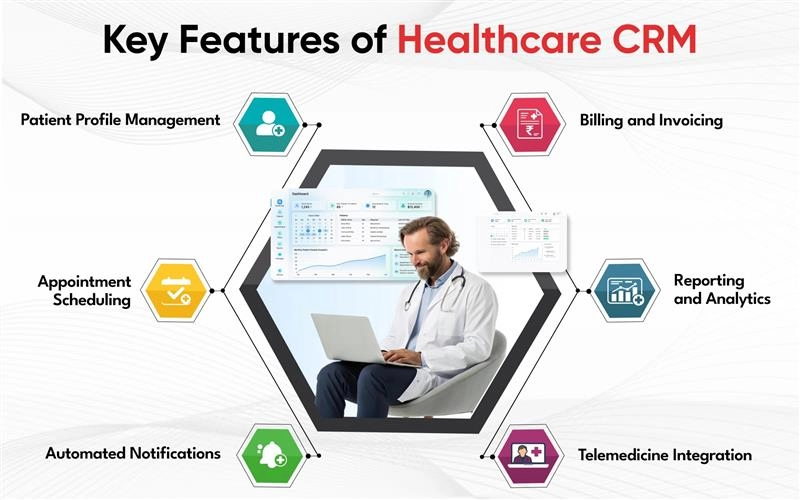
When you decide to build a CRM, you must include features that actually solve problems for medical staff. A good system should be intuitive and fast. Here are some essential features to consider:
- Patient Profile Management: An extensive store of personal details, medical records and additional insurance information.
- Appointment Scheduling: A nice calendar tool for booking, changing and canceling appointments.
- Automated Notifications: Text messages or emails reminding patients about their appointments and medication times.
- Telemedicine Integration: Video calling facility via an app or platform for remote consultation.
- Billing and Invoicing: Automatically create invoices, and make a link with the payment gateways.
- Reporting and Analytics: Diagrammatic illustration of patient satisfaction and the general performance of the clinic.
Advanced Features to Include in Your CRM
If you want to keep your lead in the market, you should probably think about including:
- AI Chatbots: Provide 24/7 assistance for common patient queries.
- Telehealth Integration: Launch video consultations directly from the CRM.
- Predictive Analytics: Spot patients who are likely to skip their appointments.
- Wearable Data Sync: Add data from fitness trackers to enhance health monitoring.
Exploring the Different Types of CRMs in Healthcare
Different systems are designed differently. Therefore, depending on what your goal is, you may choose:
- Operational CRM: This refers more to the routine activities like registration and billing.
- Analytical CRM: It uses data to detect trends in patients' behavior and outcomes.
- Collaborative CRM: It enables different hospital departments to exchange patient information thereby improving teamwork.
- Strategic CRM: Concentrates on gaining patient loyalty over a long period by means of in depth personalization and market analysis.
Step by Step Process to Create Healthcare CRM Software
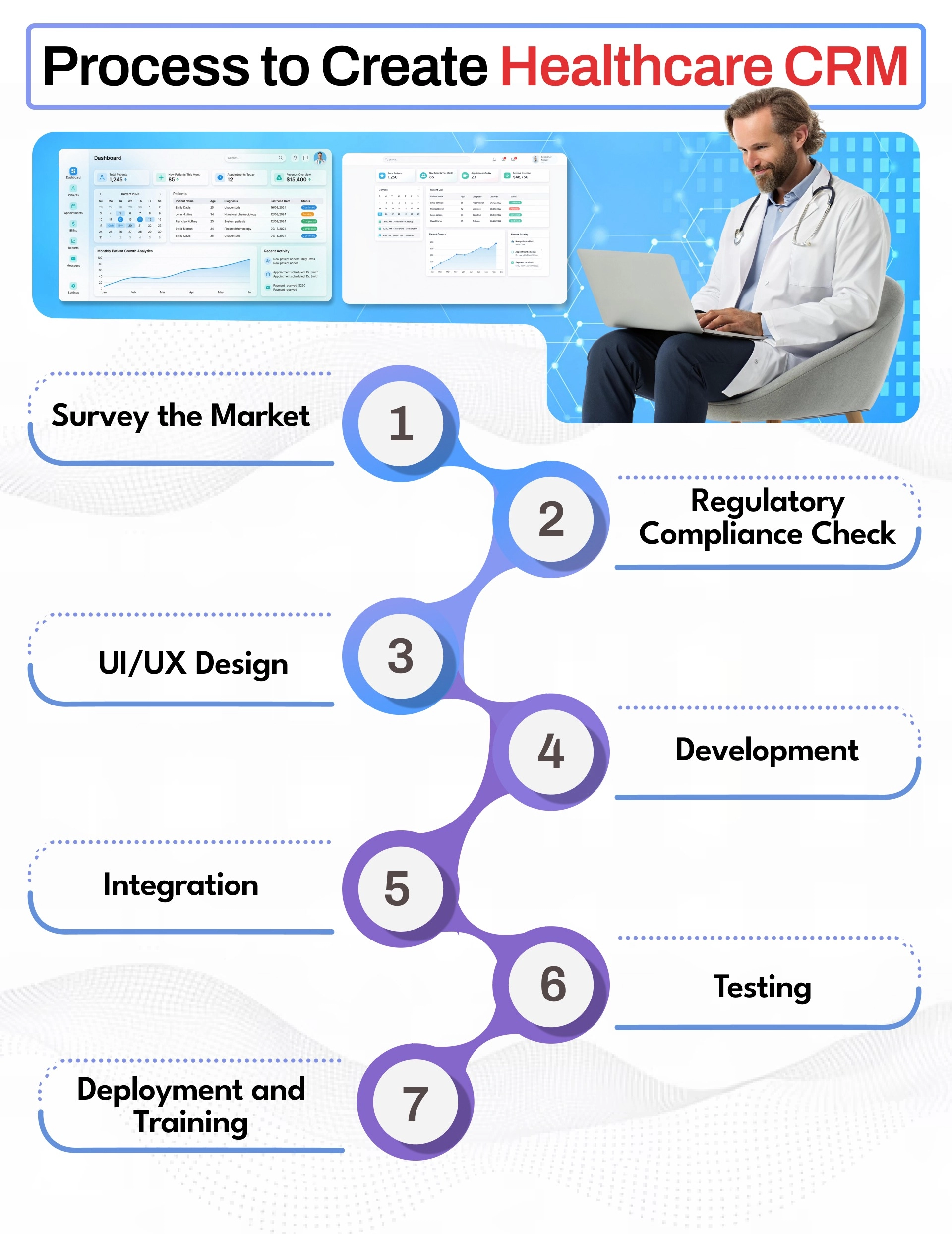
Developing a powerful Healthcare CRM Software requires following a well thought out process. You can not just jump into programming without a blueprint that also considers security and user friendliness.
- Survey the Market: Identify the specific problem areas that your CRM will address. For instance, will you be targeting the needs of isolated single small offices or large hospital chains?
- Regulatory Compliance Check: Ensure that your software meets the legal requirements of HIPAA (in the US) or GDPR (in Europe) for the protection of patient privacy.
- UI/UX Design: Design a user friendly interface. Considering that doctors and nurses have very busy schedules, the software should be extremely easy to use.
- Development: Decide on the appropriate technology stack (e.g., React, Node.js, or Python) for frontend and backend development.
- Integration: Link the CRM to the current systems of Electronic Health Records (EHR) and laboratory.
- Testing: One should conduct comprehensive testing not only for locating bugs but for ensuring data security as well.
- Deployment and Training: Deploy the application and provide training for the healthcare staff to use the software productively.
Challenges in Healthcare CRM Development
Developing a Healthcare CRM system in 2026 means that a company has to work through a number of tough legal rules, complicated data structures and the rising demand for a good patient experience.
Here are the primary challenges in healthcare CRM development, includes:
- Extensive Regulatory Compliance: The platform meets the requirements of various global and local laws such as HIPAA (US), GDPR (EU) and PIPEDA (Canada) ensuring the safety of patient information.
- Data Security and Encryption: Deploying cutting edge security techniques like AES 256 encryption for stored data and TLS/SSL for data being transmitted to avert data breaches worth millions.
- Interoperability with Legacy Systems: Opening up the CRM by connecting it with older, less standardized Electronic Health Records (EHR) and Electronic Medical Records (EMR) that lack modern API communication features.
- Data Fragmentation and Silos: Bringing together heterogeneous data from lab software, billing tools, and pharmacy systems to create a consolidated golden record for every patient.
- Adopting Interoperability Standards: One of the methods is successfully planning the data to the latest protocols such as HL7 FHIR (Fast Healthcare Interoperability Resources) that enables different health care providers to exchange data with each other in a smooth manner.
How to Choose the Best Software Development Partner?
Partnering up with the right one is the major factor in your decision making. Look for a company which not only has a portfolio of medical tech but also a deep understanding of compliance laws. They should provide transparent communication and a clearly outlined plan for the project. Reading through client reviews and asking for a detailed technical proposal will help you determine if they are in line with your vision.
Properly aligning your approach with your partners' strengths, your healthcare software is capable of defining a new mark of medical excellence. Medicine is moving towards a digital future and the CRM you have is the initial stride in that direction.
Conclusion
Developing healthcare CRM software can be a major capital outlay only to be recouped through enhanced patient care and staff productivity. A carefully planned development roadmap and a strong focus on security will enable you to create a leverage tool for healthcare. Whether you are going to pilot a small scale project or develop an enterprise level application, a technology that focuses on people's needs is always the most effective one.
Duplex stands ready to help you understand and master these complicated digital transformations. If you require support in software strategy development or want to produce healthcare related content that touches the community, give us a call at +91- 9452000089.