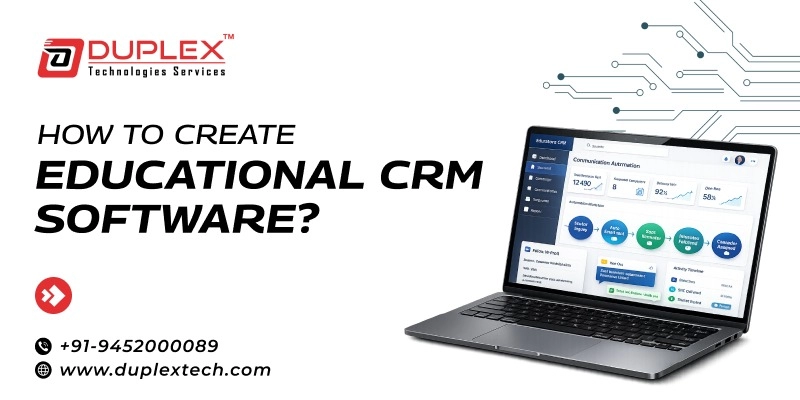
How to Create Educational CRM Software?
Posted By : Kuldeep Kr. Verma, Posted Date : Feb 28, 2026
Today, the education sector is experiencing a huge transformation due to the rapid development of digital technology. Educational institutions, which have traditionally been recognized as mere centers of learning, are now complex organizations that have to handle thousands of interactions each day. Learning how to create educational CRM software has become a priority for institutions aiming to streamline their operations. A great CRM can manage student data efficiently, facilitate communication among stakeholders and ultimately increase the number of enrollments. Educators who decide to create their bespoke software will be able to cater to their unique management requirements accurately and conveniently.
If you are looking to build a solution that streamlines campus management and improves student engagement, you are in the right place. At Duplex Blogs, we specialize in breaking down complex tech processes into simple, actionable steps.
Table of Contents
- What is Education CRM Software?
- Why Does Your Institution Need a Custom CRM?
- Education CRM Market Overview
- Core Features of an Effective Education CRM
- Types of Data Collected by Educational CRMs
- Step by Step Process to Build Your Education CRM Software
- Benefits of Using Education CRM Software
- CRM Solutions for Different Educational Sectors
- Challenges in Building Educational CRM Software
- Conclusion
What is Education CRM Software?
An Education CRM software is a platform specifically developed to handle the complete student lifecycle. Different from a generic CRM of retail, an education focused system deals with lead management for admissions, course enrollments, student engagement and alumni relationships. It is a centralized database where faculty, administration and students can communicate effortlessly.
Choosing the proper software allows educational institutions to stop using disorganized spreadsheets and paperwork for entering data. They get an overview of their operations which enables them to answer every student query and close every enrollment opportunity.
Why Does Your Institution Need a Custom CRM?
Every educational institution runs its own unique workflows. A language school will obviously have different requirements than, say, a technical university. Pre-made, off the shelf solutions usually have too many bloated features that you don't need but at the same time, they don't have the niche tools that you really require. Developing a tailor made Education CRM software means you can extend the software functionalities for your very business processes. For example, you can automate the mundane, repetitive tasks of sending out reminders for tuition fee payments or updating applicants on their application status. This way, the work of your employees is optimized so that they can concentrate on the most important stuff, like delivering high quality education.
Education CRM Market Overview
The global market for educational CRM solutions is experiencing rapid growth as institutions embrace digital transformation. Schools are moving away from legacy systems to cloud-based platforms that offer scalability and remote access. Recent data shows a significant increase in budget allocations for EdTech tools. This change is coming about because the buyers are demanding more personalized learning experiences and efficient lead conversion. The study of the market reveals that it is getting more competitive and the main idea here is the deployment of AI and automation to facilitate student engagement.
Core Features of an Effective Education CRM
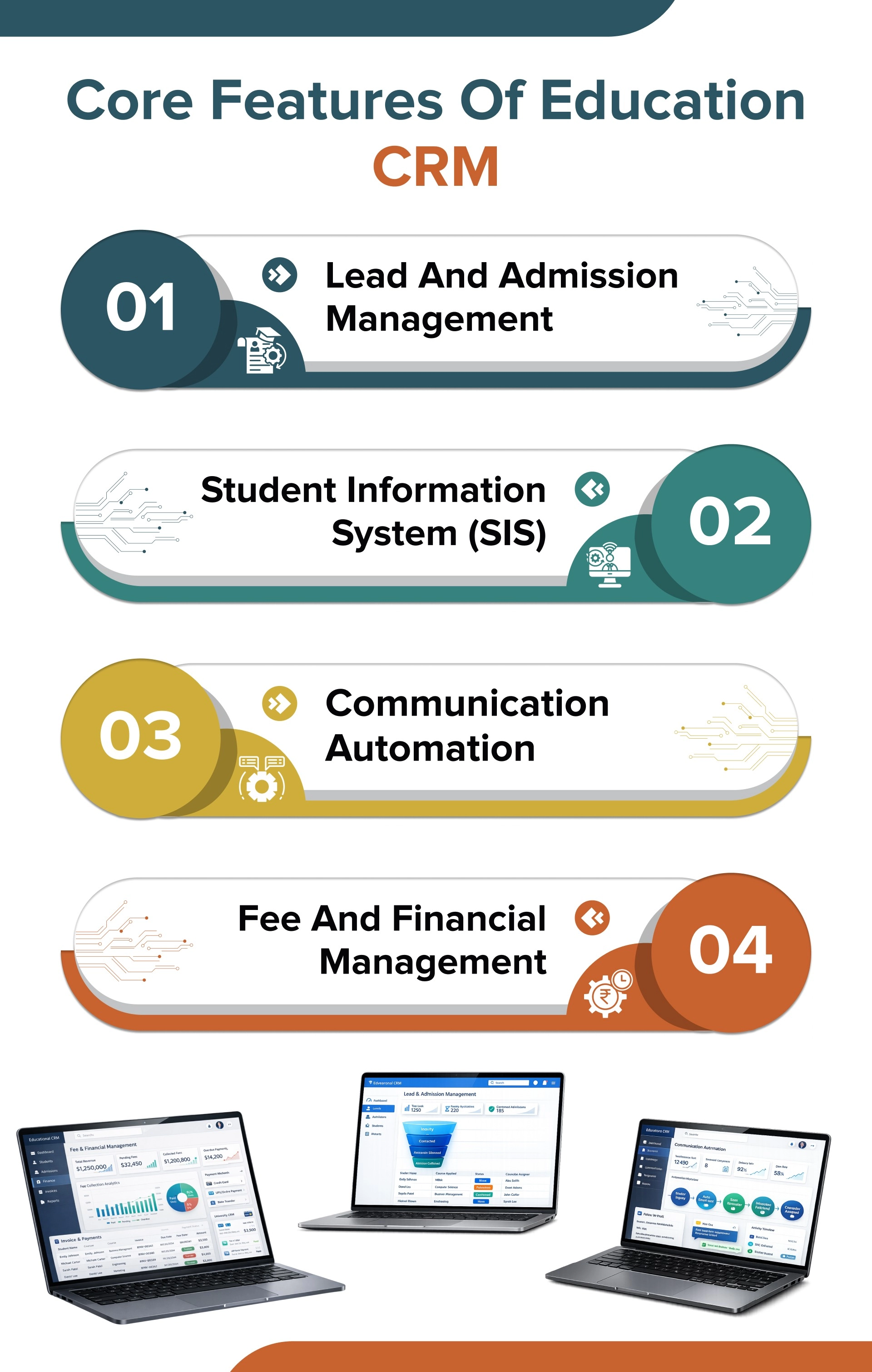
In order to build an effective CRM, you have to center your attention on features that meet the real challenges of educators. Below are the essential components:
Lead and Admission Management
The journey begins when a prospective student visits your website. The CRM needs to have the capability to pick up these leads automatically and sort them according to the courses that the students have shown interest in. It must give the admissions team permission to monitor the status of each application, right from the first inquiry up to the final enrollment.
Student Information System (SIS)
Once a student is enrolled, the CRM becomes their digital home. This module stores personal details, academic records, attendance, and behavioral notes. Having this data in one place helps teachers provide personalized support to students who might be struggling.
Communication Automation
Manual emailing is a thing of the past. A high-quality Education CRM software integrates email, SMS, and WhatsApp notifications. Whether it’s an announcement about a campus event or an automated reminder for an upcoming exam, the system keeps everyone in the loop.
Fee and Financial Management
Keeping track of tuition fees, scholarships, and refunds can be a real challenge. An integrated billing module enables parents to pay fees through the internet and at the same time, it gives the institution up to date reports of outstanding payments and the increase of revenue.
Types of Data Collected by Educational CRMs
A good CRM gathers different types of data to give a comprehensive student profile view. For example, it may comprise:
- Personal Details: Names, addresses and phone numbers.
- Academic Records: Past grades, transcripts and attendance records.
- Communication Records: Email, telephone and meeting logs.
- Financial Records: Tuition payments, scholarships and unpaid balance.
- Behavioral Records: Level of student engagement on portal and course progress.
Collecting this data helps in creating personalized communication strategies for every learner.
Step by Step Process to Build Your Education CRM Software
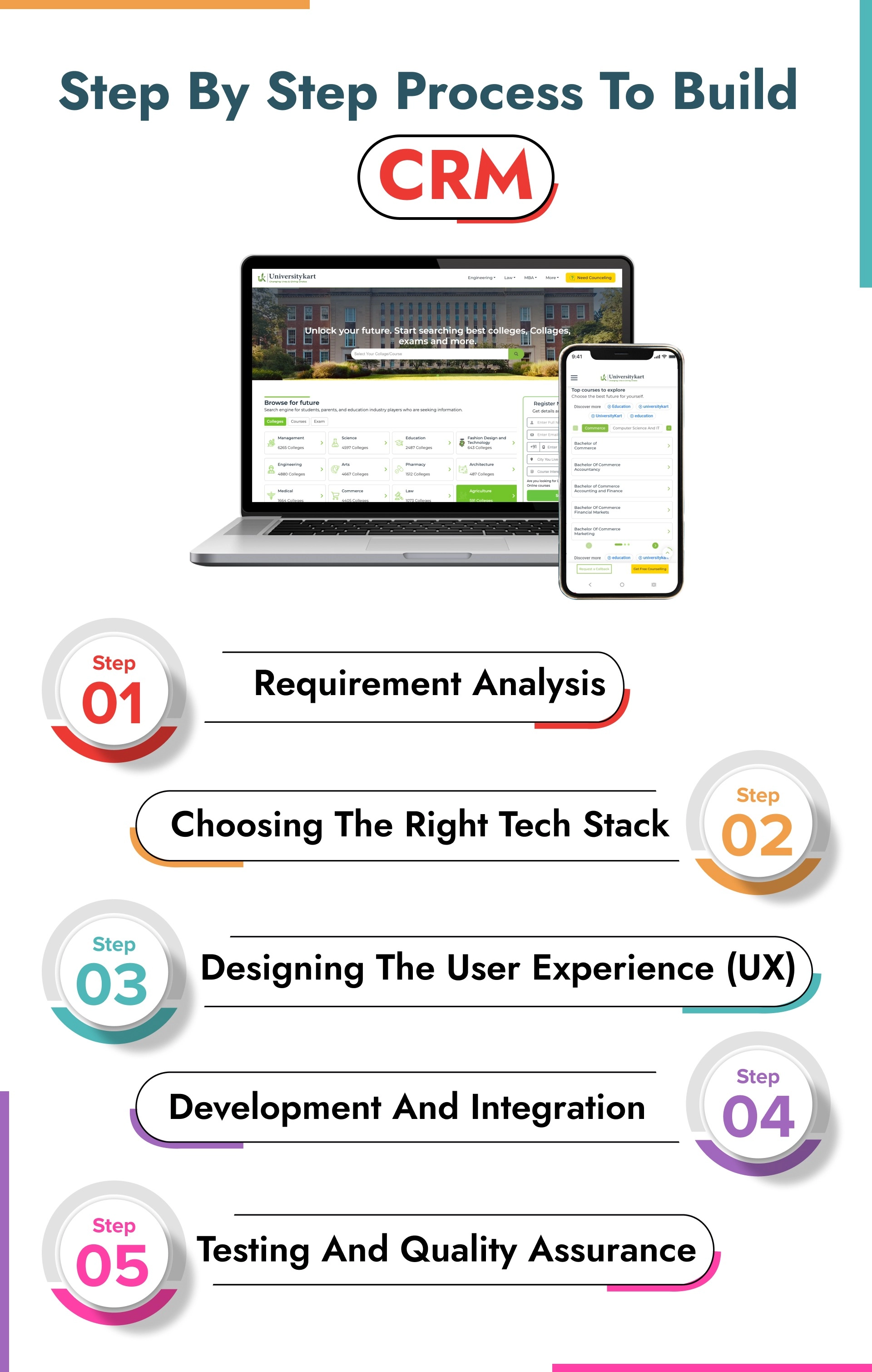
Creating a software product is a journey that requires careful planning. Following a structured approach ensures that the final product meets the needs of all stakeholders.
Step 1: Requirement Analysis
Identify the problems of your current system first. Interview admission officers, teachers, and even students. Who knows, they may find it difficult to track applications or Is it communication that is disjointed? Clear definition of these problems will give you a very good leverage when you decide on the features which are absolute necessities in your case as opposed to the ones that are just nice to have.
Step 2: Choosing the Right Tech Stack
The technology used to build your CRM software will largely determine how well it performs. React or Angular, for instance, are top rated front end frameworks for developing highly responsive interfaces. As for the back end, if you want to handle thousands of student records comfortably, you should consider Node.js or Python (Django/Flask). When it comes to the database, both PostgreSQL and MongoDB have proved to be perfect for handling highly complex data relationships.
Step 3: Designing the User Experience (UX)
A CRM for Education should be easy to use. Teachers and school administrators are generally very busy, hence they cannot afford to get lost in a maze of complicated menus. The design ought to be minimalistic, with a dashboard showing at a glance the main things to be done that day, e.g., calls to be made, enrollments etc.
Step 4: Development and Integration
A major consideration during the build phase should be the CRM's structural flexibility, i.e. it should be possible to upgrade/improve one part of the system without causing the entire system to collapse. Besides that, your CRM must be able to interact or work seamlessly with your school website, learning management systems (LMS), and accounting software.
Step 5: Testing and Quality Assurance
There must be thorough testing before the software goes live. Apart from bug hunting which will help expose any faults or defects, there should be load testing to assess if the system can still work properly under a heavy load such as during the peak of the admission season. Given the fact that educational establishments deal with sensitive student records and financial data security testing assumes the highest level of importance.
Benefits of Using Education CRM Software
Introducing a CRM system brings a lot of benefits to the contemporary organizations:
- Improved Enrollment: Automates lead nurturing to convert inquiries into admissions.
- Centralized Data: Keeps all records in one place, reducing manual errors.
- Better Communication: Autonomously facilitates broadcast of messages for exams, tuition and events etc.
- Productivity Gains: Staff have more time as the system handles the repetitive paperwork.
- Data Driven Decisions: Offers in depth analysis on student performance and other key educational metrics.
Overall, these advantages contribute to an educational institution that is not only orderly but also highly professional.
CRM Solutions for Different Educational Sectors
Each industry calls for a specific set of CRM features:
- K12 Schools: Concentrate more on parent teacher communication and daily attendance.
- Universities: Give utmost importance to student admissions, internship tracking and alumni relationships.
- Instructional Institutes: Require lead management and scheduling features for different batches in the biggest way.
- Online Learning Platforms: Must have the capability of integrating with Learning Management Systems (LMS) and also track the progress of the students.
- Trade Schools: Concentrate on skill assessments and follow up studies of graduate placement in their career.
All sectors have different issues; hence the CRM should be versatile enough to accommodate different organizational layouts and educational objectives.
Challenges in Building Educational CRM Software
Developers often face several hurdles when creating these platforms:
- Data Security: Securing sensitive student data against hackers and other cyber threats.
- Integration: Making the CRM work together seamlessly with existing Learning Management Systems (LMS).
- User Adoption: Encouraging the staff to abandon the conventional methods and embrace the new technology.
- Scalability: Making sure the system is capable of supporting thousands of users during the busy admission periods.
Overcoming these challenges requires a focus on high-end encryption and providing extensive support through Duplex Blogs at +91-9452000089.
Conclusion
Understanding how to create educational CRM software is the first step toward a more organized and successful institution. By focusing on the users and considering only the features of essential nature, you can create a tool that will profoundly optimize the work of the administration. No matter if you are a small school or a big university, proper Education CRM software will assist you in engaging your students more effectively. To know more about the software trends or to get started on your project, please contact Duplex Blogs at +91 9452000089. Technology investment today is the key to a brighter, more efficient future of education in the world.